
Understanding the Protein Craze: What’s Driving the Surge in Demand
Protein is everywhere right now. From protein popcorn to protein cold foam, the message of ‘Eat more protein’ feels inescapable.
In fact, when we mapped online conversations last year as part of a narrative research project, protein didn’t just dominate food discourse—it outpaced conversations about Beyoncé.
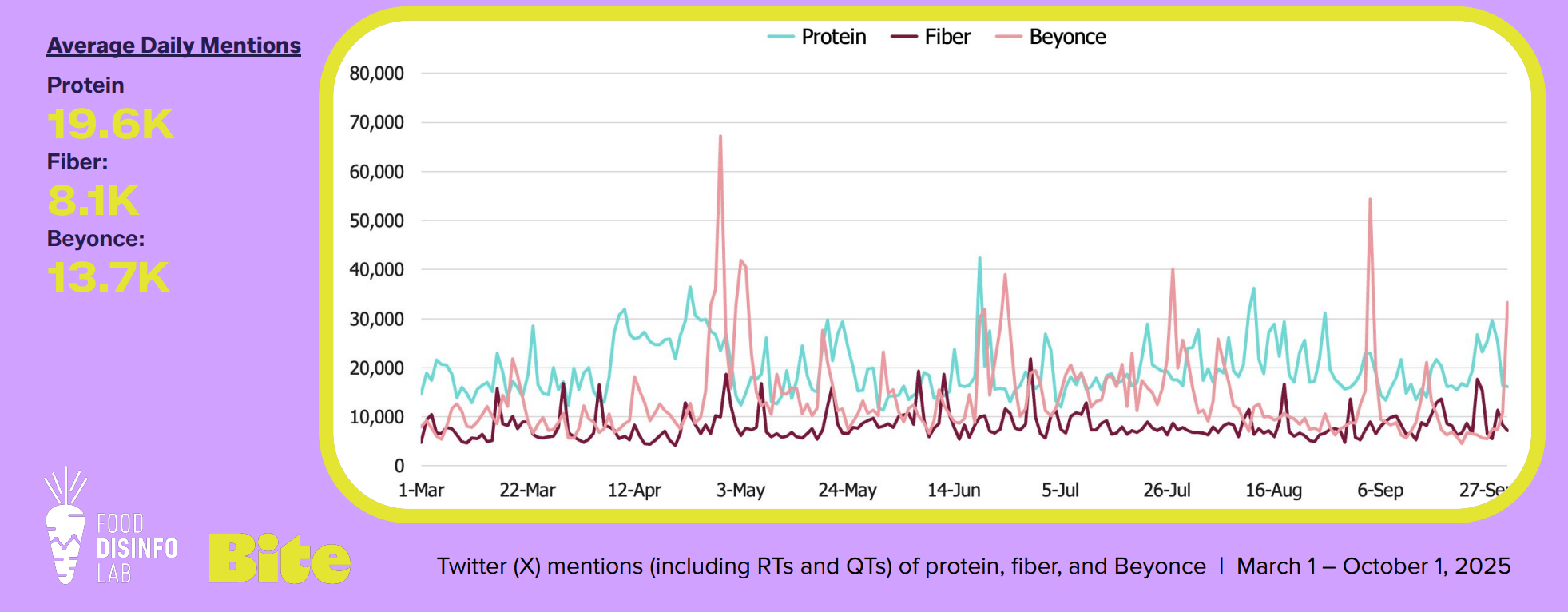
That insight kicks off Peak Protein: Opportunities and Challenges for Plant Protein, a new social listening report from BITE: Building Impact Through Eaters, developed in partnership with Food DisInfo Lab. The research digs into how protein is talked about online, who’s driving the conversation, and—most importantly—where there’s real opportunity to build climate-smart, plant-forward norms. BITE’s work focuses on making climate-smart food choices the norm, so we pay close attention to what’s happening in food culture. Our narrative and behavioral design approach is grounded in understanding the forces shaping how people think about food, making this research an opportunity to better understand the recent rise in protein demand and what’s driving it.
Why Are We So Obsessed With Protein?
America’s protein fixation didn’t come out of nowhere.
For decades, animal protein has been framed as essential, superior, and “normal”—from World War II–era nutrition messaging to the cultural staying power of Got Milk? and Beef: It’s What’s for Dinner. Since the 1980s, diet trends like Atkins, Paleo, Keto, and now GLP-1–driven weight-loss culture have only intensified the focus on protein—often animal protein.
The result? A deeply ingrained association between protein and meat.
Nearly 90% of U.S. adults incorrectly believe eating meat, dairy, or eggs is essential for adequate protein intake (PCRM/Morning Consult). Poultry, dairy, eggs, and red meat remain the most common protein sources. And yet, our research shows something surprising beneath the surface of this assumption.
Who’s Actually Driving the Protein Conversation?
Working with network analysis firm Graphika, we mapped roughly 15,000 social media accounts actively engaging in protein discourse to understand whether the protein hype is mostly organic or orchestrated. What emerged wasn’t a single dominant narrative, but a fragmented landscape with polarized, loud voices on either end of the spectrum: MAHA-aligned, meat-centric influencers on one end, and vegan advocates on the other.
We uncovered content creation largely influenced by personal incentives. Across both meat-based and plant-based spaces, most influential accounts are monetizing attention—selling books, supplements, coaching programs, podcasts, or apps.
And while, yes, we did find clear evidence of industry-backed influencer campaigns, those campaigns aren’t large enough to explain the sheer scale of protein content online. Instead, these influencers often stir up anxiety about health, then position their products as the solution—amplified further by low-quality AI-generated content.
Here’s the Good News: Most People Aren’t Ideologues
Despite the noise, one of the most important findings of this research is also the most hopeful:
The majority of protein conversations online are not extremist, partisan, or anti-plant. Most fall somewhere in the “messy middle.”
Most people aren’t trying to “pick a side.” They’re just trying to feel healthy, meet their fitness goals, stay full and energized, or figure out what to eat for dinner.
And that leaves room for plant-based foods to be part of the protein discussion. When we analyzed posts across Instagram, TikTok, YouTube, Reddit, Facebook, and X, we saw that plant-based conversations overlap more with general protein discourse than any other category.
Even more telling: only 21% of the highest-engagement protein recipes center meat as the main protein source. Most feature plants (such as beans or vegetables), dairy, eggs—or a mix.
Protein, it turns out, is often just a supporting character. Think: cold foam on a matcha latte. Spirulina in a smoothie. Cashews blended into sauce. A “protein boost,” not a center-of-the-plate identity statement.
Across platforms, we saw a clear throughline. People want practical guidance: recipes and simple ways to meet their needs.
The Opportunity for Plant Protein
So what does all of this mean? Just because protein has been culturally linked to meat doesn’t mean that association is fixed.
BITE’s work on narrative design and perception change is based on research that shows that cultural associations are flexible, and always shifting.
This creates a powerful opportunity to build new norms that center beans, lentils, and other plant proteins on the plate .
Five Principles for Moving Forward
Based on what we found, here’s what works—and what doesn’t:
Meet people where they are. People aren’t searching for plants or meat. They’re searching for relief, energy, and feeling okay.
Show, don’t compare. You don’t need to argue against meat to elevate plants. A great recipe does the work.
Ride existing trends. Protein, fiber, whole foods—go where the conversation already is.
Avoid triggering identity battles. Celebrate plant protein without vilifying other choices.
Don’t play whack-a-mole with misinformation. Lead with engaging, accurate content instead.
Why This Matters Right Now
Foodservice operators—restaurants, college and university dining halls, workplace cafes, and others—play a critical role in shaping what we eat. As dietary guidelines and institutional norms continue to emphasize meat, there’s a real risk that operators respond by serving more of it—despite what people are actually looking for.
“BITE’s research shows that eaters want protein. What they don’t require is that it comes from animals.”
The future of protein isn’t about forcing a swap. It’s about expanding the definition—and making plant-forward choices feel normal, desirable, and easy.
👉 Read the full report: Peak Protein: Opportunities and Challenges for Plant Protein
Dive deeper into the data, network maps, and narrative insights shaping the future of food culture.
