
PRESS RELEASE: New research finds a definition gap may be slowing plant-forward progress in contract foodservice
FOR IMMEDIATE RELEASE
CHICAGO, IL – September 23, 2026 – What if one of the biggest barriers to expanding plant-forward menus isn’t the food itself, but what people think “plant-forward” means?
In eight first-of-their-kind peer roundtables led by BITE: Building Impact Through Eaters in partnership with Aramark and Sodexo, with support from Greener by Default, 112 foodservice operators from Healthcare, College & University, Business & Industry, and Sports & Entertainment shared their perspectives on expanding plant-forward menus. The participating organizations collectively serve approximately 280 million eaters each year. Across seven of the eight roundtables, participants reported seeing plant-forward menus as potentially conflicting with three core priorities of their work: cost management and guest and client satisfaction.
But across the conversations, another pattern emerged. Even after participants were given a shared definition at the start of each session, many continued to interpret “plant-forward” as “plant-based”—a much narrower idea.
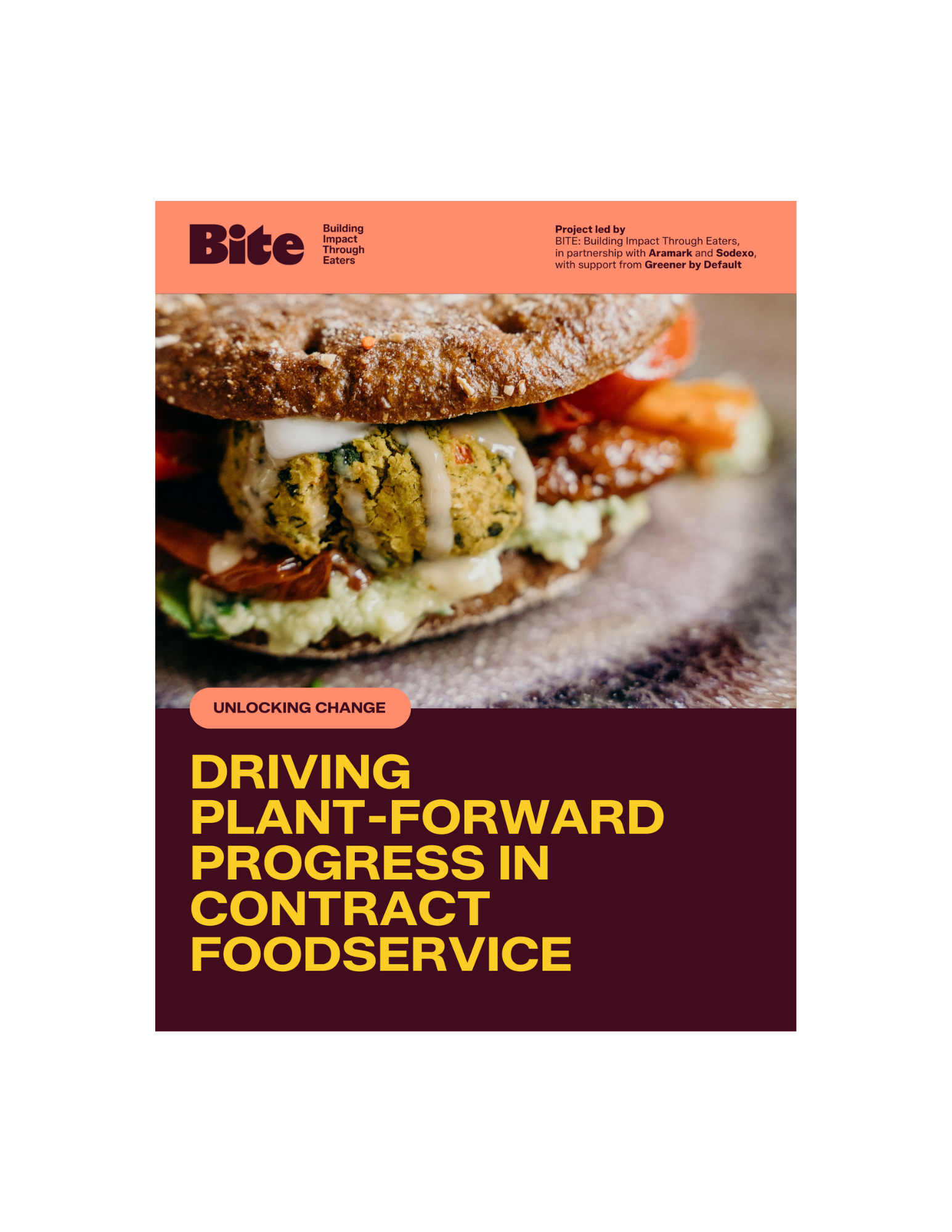
That insight is at the center of Unlocking Change: Driving Plant-Forward Progress in Contract Foodservice, a new report from BITE exploring what frontline foodservice professionals say is helping—and hindering—efforts to expand plant-forward menus in real-world operations.
BITE defined “plant-forward” as dishes that feature plant proteins and other plant ingredients as the main components. That can include vegan and vegetarian dishes, but also omnivorous dishes in which smaller amounts of meat, dairy, eggs, or other animal products play a supporting role.
That distinction is important. Participants frequently associated plant-forward menus with a relatively narrow set of products—such as tofu, tempeh, jackfruit, and meat alternatives—and raised concerns about sourcing, storage, labor, familiarity, and guest demand. A broader understanding opens up a much larger menu: beans and lentils, familiar comfort foods with strategic swaps or blends, globally inspired dishes, and meals that use plants as the center of gravity without requiring meat to disappear entirely.
“One of the clearest opportunities we heard is to make plant-forward easier to understand and easier to execute,” said Sophie Egan, Director of Strategy, BITE: Building Impact Through Eaters. “That means clarifying what plant-forward actually means, building the business case with evidence, and giving culinary teams the flexibility and support to make it work for their guests and operations.”
What frontline teams told us
Three themes surfaced across the roundtables:
Plant-forward is often misunderstood and undervalued. Participants described skepticism among both staff and guests, with plant-forward dishes frequently assumed to be only vegan, unfamiliar, or less satisfying before they are tried. Several participants described taste tests as an effective way to dissolve that resistance.
Guest expectations weigh heavily on operators. Participants across segments often connected plant-forward menus with the risk of disappointing guests or clients. Previous pushback on individual menu items could become evidence, in their minds, that a broader plant-forward strategy would not work.
Certain ingredients can create real operational challenges. When plant-forward is understood primarily through niche or specialty products, operators may encounter regional availability gaps, large case sizes, limited storage, unfamiliar preparation techniques, and challenges using ingredients across multiple dishes.
The findings point to an opportunity to approach plant-forward menu shifts differently.
Instead of leading primarily with sustainability, BITE recommends building confidence at both the operational and individual levels: testing menu changes, tracking eater satisfaction and sales, sharing internal success stories, and making the business case visible. The report also recommends giving culinary teams more opportunities to shape solutions themselves, while simplifying sourcing through familiar, versatile ingredients and flexible recipes that can work across regions and operations.
The opportunity is significant. BITE’s 2026 Closing the Gap: Eater and Operator Perspectives on Sustainable Dining research with Datassential found that 40% of guests plan to eat meals with less or no meat or animal protein in the coming year, while only 20% of foodservice operators plan to create them. Separate research from the Menus of Change University Research Collaborative has found that a plant-forward shift across dozens of colleges and universities reduced food costs by 11%.
The challenge, then, may be less about convincing people to accept sacrifice—and more about expanding what plant-forward can look like in the first place.
Note: The findings are qualitative and reflect participants’ perceptions shared during the roundtables; they should not be interpreted as company-wide policies, practices, or beliefs.
👉 Download Unlocking Change: Driving Plant-Forward Progress in Contract Foodservice to explore the full findings and recommendations.
About BITE
BITE: Building Impact Through Eaters is a nonprofit working to make climate-smart food choices the norm by translating narrative and behavioral science into practical, real-world solutions. We combine deep expertise in food trends and food systems to connect sustainable foods with eaters’ needs, values, and cultures.
For more information about this report, please contact: sophie@wearebite.org.
